Artist: Yeni Mao
Type: Sculpture, Installation
Date: 2022
Dimensions: 122 × 377 × 203 cm
Work Description:
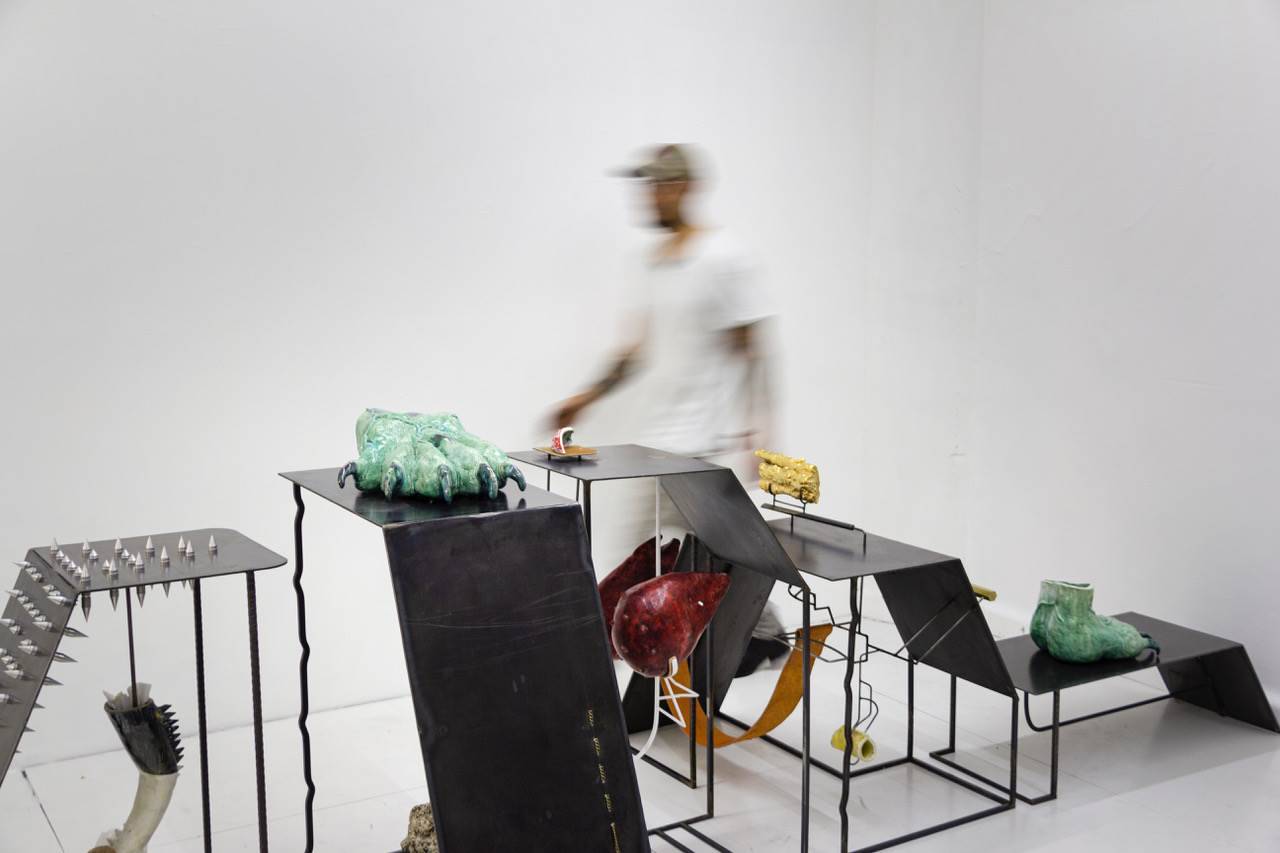
Mao studied art in Chicago and in recent years has settled in Mexico City, where he appears deeply fascinated by the local tradition of covering surfaces with tiles, as well as by the exposed rebar structures found throughout the city’s architecture. His works make extensive use of negative space: steel rods and wires trace voids, while rocks and leather straps are suspended in midair. Their cage-like frameworks suggest the often-overlooked constraints that architecture imposes on the body.
While his interest in local architecture and his choice of primary materials remain consistent, these recent works turn formally toward the past. At the center of the exhibition stands fig 33.1–5 yerba mala (2021), a complex, platform-like sculpture that echoes the stepped forms of Mexico’s many pyramids. Its structure is composed of a series of dark steel modules designed to support, hold, or restrain other elements, including stone, metal, leather, and ceramics. Whereas Mao’s earlier works often appeared as isolated, vividly colored, fetishistically charged figures, this sculpture presents a more intricate network of connections and a dynamic collective posture.
At the front of the work is a massive turquoise cat’s paw with claws fully extended. Behind it, several modules bear gold- and nickel-plated volcanic rock—perhaps the most ubiquitous material in central Mexico. Additional details include leather straps, but the most striking elements are ceramic. From a steel platform at the center hang two swollen, lung-like terracotta forms, pierced with white supports that carry a clinical quality. At the rear, a black-and-white cylindrical form with spiked fins descends from another module. Above it appears yet another turquoise cat’s paw, whose most unsettling detail is that its little claw has been replaced by a sharp piece of metal.
Ultimately, Mao’s pyramid assembles into a body—but not a human one. It evokes the jaguar, the supreme mythical beast that appears throughout countless Mesoamerican cosmologies. It is as if the constrained bodies that have populated his earlier works here acquire a new kind of force—one that awakens within certain limits, or despite them.